 ← PostgreSQL Blog
Understanding PostgreSQL Architecture
Understanding PostgreSQL Architecture
PostgreSQL, often referred to as Postgres, is a powerful open-source relational database management system (RDBMS). It has gained popularity due to its robustness, extensibility, and adherence to SQL standards. To fully leverage its capabilities, it’s essential to understand its architecture. In this article, we will delve into the architecture of PostgreSQL to provide a comprehensive overview.
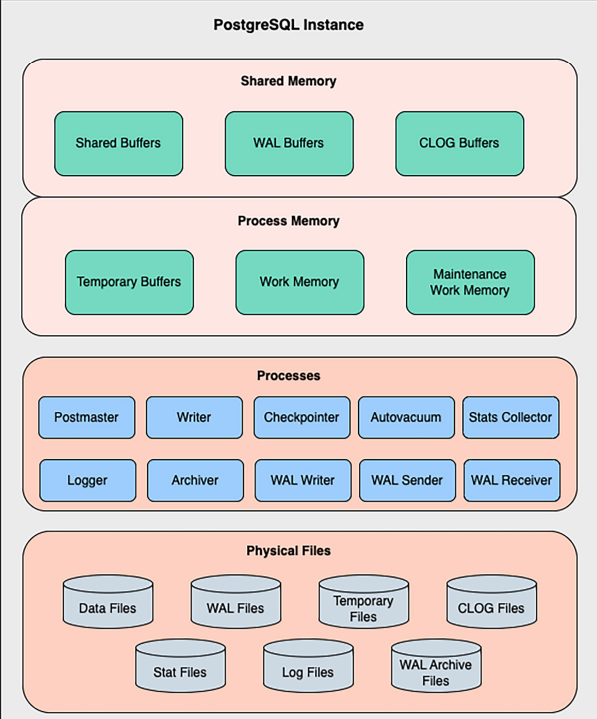
Components of PostgreSQL Architecture
1. PostgreSQL Server
At the core of PostgreSQL is the PostgreSQL server, which manages all database operations. It receives client requests, processes SQL queries, and interacts with the underlying database files to retrieve or store data.
2. Shared Memory and Processes
PostgreSQL utilizes a multi-process architecture with shared memory for communication. When the server starts, it spawns several processes:
- Postmaster: The parent process that manages the startup and shutdown of other processes.
- Worker Processes: Multiple worker processes handle client connections and execute queries concurrently.
Shared memory facilitates communication between these processes, enabling efficient data exchange and synchronization.
3. Storage Manager
PostgreSQL employs a storage manager responsible for managing data storage and retrieval. It interacts with the file system to manage database files, including:
- Heap Files: These contain table data stored as rows.
- Index Files: These store index data to speed up data retrieval operations.
- WAL (Write-Ahead Logging): WAL files ensure data durability by logging changes before they are written to the main database files.
4. Query Planner and Optimizer
When a SQL query is submitted to PostgreSQL, it undergoes a multi-step optimization process:
- Parser: Parses the SQL query to ensure syntactic correctness.
- Rewriter: Transforms the query into an equivalent form that can be optimized.
- Planner: Generates a query execution plan based on statistics, available indexes, and other factors.
- Executor: Executes the optimized query plan and retrieves the results.
This optimization process ensures efficient query execution and optimal performance.
5. Extensions and Add-ons
PostgreSQL’s architecture supports extensions and add-ons that provide additional functionality:
- Stored Procedures: Custom functions written in languages like PL/pgSQL, PL/Python, etc.
- Foreign Data Wrappers (FDW): Allows PostgreSQL to query data stored in external databases or file systems.
- Extensions: Modular components that extend PostgreSQL’s capabilities, such as PostGIS for geospatial data processing.
Conclusion
Understanding the architecture of PostgreSQL is crucial for optimizing performance, ensuring data integrity, and leveraging its advanced features. By grasping the roles of its components, from the server and storage manager to the query planner and extensions, developers and database administrators can make informed decisions to design and maintain efficient PostgreSQL databases.