 ← PostgreSQL Blog
Why the Future of Postgres is Autonomous
Why the Future of Postgres is Autonomous
For decades, we’ve been told we have two choices. You either pay the Cloud Tax to giants like AWS for a managed service (and lose control over your database and costs), or you hire a small army of DBAs to manage your own clusters.
But a third path has emerged: The Autonomous Database.
Table of Contents
- The Shift: From Managed Services to Autonomous Infrastructure
- What is Autobase? The Bridge Between Control and Ease
- The Architecture of Autonomy: How it Works
- Founder Spotlight: A Q&A with Vitaliy Kukharik
- Looking Ahead: The 2-Year Roadmap
- Conclusion: Taking Back the Reins
1. The Shift: From Managed Services to Autonomous Infrastructure
While managed cloud database solutions made life easy, they created “black boxes.” If you need a specific PostgreSQL extension or custom kernel tuning for a high-throughput workload, you’re often out of luck.
Autobase is different. It uses code (like Ansible and Go) to codify the expertise of a Senior DBA. Instead of renting a database, you are deploying a self-healing system on your own hardware.
2. What is Autobase?
Autobase isn’t just another wrapper; it is a lifecycle management platform for PostgreSQL. It handles the scary parts of database administration:
- BYOC (Bring Your Own Cloud): Autobase can automatically provision the required infrastructure (VMs, load balancers, and object storage buckets for backups) across AWS, Azure, GCP, DigitalOcean, and Hetzner Cloud.
- High-availability clusters (Patroni-based): Deploy reliable HA PostgreSQL clusters with automated orchestration and failover.
- Backups + full-cluster restore with PITR: Point-in-Time Recovery so you can restore to an exact timestamp.
- Upgrades with minimal or zero downtime: Minor and major upgrades, including in-place upgrades (minimal downtime) and blue-green deployments (zero downtime).
- Scaling and read distribution: Add new nodes and scale read traffic by routing queries to replicas.
- Day-2 operations: Create roles and databases, manage users/privileges, install extensions, and more.
3. The Architecture of Autonomy
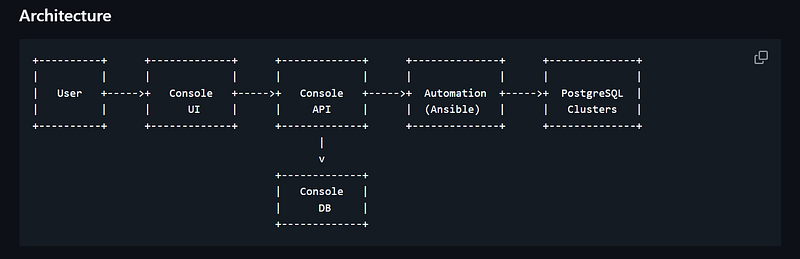
At its core, Autobase uses a sophisticated orchestration layer to monitor the health of your Postgres fleet. The project consists of two main parts:
- Console — a web application (UI, API, DB) for cluster management, monitoring, and operations.
- Automation — an automation system based on Ansible (playbooks and roles) for deploying, upgrading, and maintaining PostgreSQL clusters.
Console and Automation are tightly integrated: users interact via the UI, which sends commands to the API. The API, when necessary, triggers Ansible playbooks to automate cluster operations.
4. Founder Spotlight: A Conversation with Vitaliy Kukharik
To understand where Autobase is going, I sat down with the creator himself, Vitaliy Kukharik, to talk about the spark that started it all.
Q1: The Spark what was the specific moment or frustration that made you say Existing solutions are broken I need to build Autobase
Vitaliy: Around mid-2018 I hit a breaking point: the number of PostgreSQL servers I managed kept growing, but everything was still done manually. The infrastructure wasn’t as stable as it needed to be, and each new cluster meant more repetitive work, more risk, and more time spent firefighting.
At the time I was the only person responsible for the database infrastructure, and building a full DBA team wasn’t an option. So I decided to build a tool that would let one person run a large, high-availability Postgres fleet with the same — or better — reliability as a dedicated team. That’s how Autobase started: first as Ansible-based CLI automation to deploy HA clusters, and eventually it grew into a platform that covers almost the entire PostgreSQL lifecycle. The mission is simple: make the hard parts of self-hosting Postgres feel as easy as using a managed service like AWS RDS — without giving up control.
Q2: The Team I’m curious about the humans behind the code. How big is the team right now and what is the culture like? Are you fully remote?
Vitaliy: Autobase is an open-source project built together with the community. While I’m currently the main maintainer and contribute a lot personally, Autobase is not a solo effort — people and companies contribute improvements, fixes, and new features through pull requests. We review every PR carefully, and good ideas get merged.
Contributors are distributed globally, so the workflow is naturally fully remote and asynchronous. If you want to see who’s involved, GitHub shows the full contributor list here: https://github.com/vitabaks/autobase/graphs/contributors
Q3: The Why You The database market is crowded with giants like AWS and startups like Supabase. Who is the exact user that Autobase is built for and why should they choose you over the big guys?
Vitaliy: Autobase is built for teams who want the power and control of self-hosted PostgreSQL without reinventing operations from scratch.
Managed databases are great — until you hit constraints: no SSH access, limited extensions, restricted configs, vendor-specific features, or pricing that grows quickly at scale. Autobase gives you a “managed-like” experience on your own infrastructure: automation, repeatability, and a clear operational model — while keeping full control and portability.
Also, Autobase wasn’t originally built to “compete” with the cloud — it was built because we needed it ourselves in real production environments. That practical, ops-first origin still defines the project today.
Q4: What has been the biggest non technical challenge you’ve faced while growing the company so far?
The biggest non-technical challenge has been turning a deeply technical tool into a real product. We’ve made strong progress in making Autobase accessible beyond expert-only usage, but we’re still in the phase of evolving from a “project” into a “company.”
That means finding a sustainable funding model while keeping the project’s values intact — staying open source without locking key features behind a paywall. Right now Autobase remains a community-driven effort, and I’m actively looking for sponsors: some who want to support the project voluntarily, and others who prefer a commercial relationship through professional support.
Q5: The Future: Where is Autobase in 2 years?
Vitaliy: In the next two years, the focus is to make Autobase the best Postgres automation platform for serious production workloads. We’ll keep doubling down on reliability, operational simplicity, and features that matter when Postgres is running large, high-throughput systems.
In the near term, we’re shipping zero-downtime major upgrades via blue-green deployments in the next release. Looking further ahead (3.0), we plan to redesign the proxy layer and introduce sharding for very large databases, plus expand Autobase Console so more day-to-day operations become a few clicks. We’re also discussing an integration with Zexa Technologies’ DBDesk, which would bring a SQL editor directly into Autobase Console.
Overall, I see Autobase becoming the default “bring your own cloud” way to run PostgreSQL: a platform that gives you managed-service ergonomics, but with full control, transparency, and production-grade automation.
5. Looking Ahead: The 2-Year Roadmap
The introduction of Blue-Green deployments is a game-changer for teams that cannot afford even a few seconds of maintenance window downtime. By integrating tools like DBDesk, Autobase is moving from a backend utility to a full-stack database management ecosystem.
6. Conclusion: Taking Back the Reins
The “Cloud First” era is transitioning into the “Control First” era. As costs rise and data sovereignty becomes more important, tools like Autobase provide the middle ground we’ve been waiting for.
You don’t need a 10-person DBA team to have a world-class database. You just need the right automation.
A huge thank you to Vitaliy Kukharik for taking the time to share these insights. In an era where Open Source is often used as a marketing buzzword, it’s refreshing to speak with a founder who is genuinely committed to the community and the “ops-first” philosophy. His journey from a solo DBA to building a global project is a testament to the power of solving your own frustrations.